
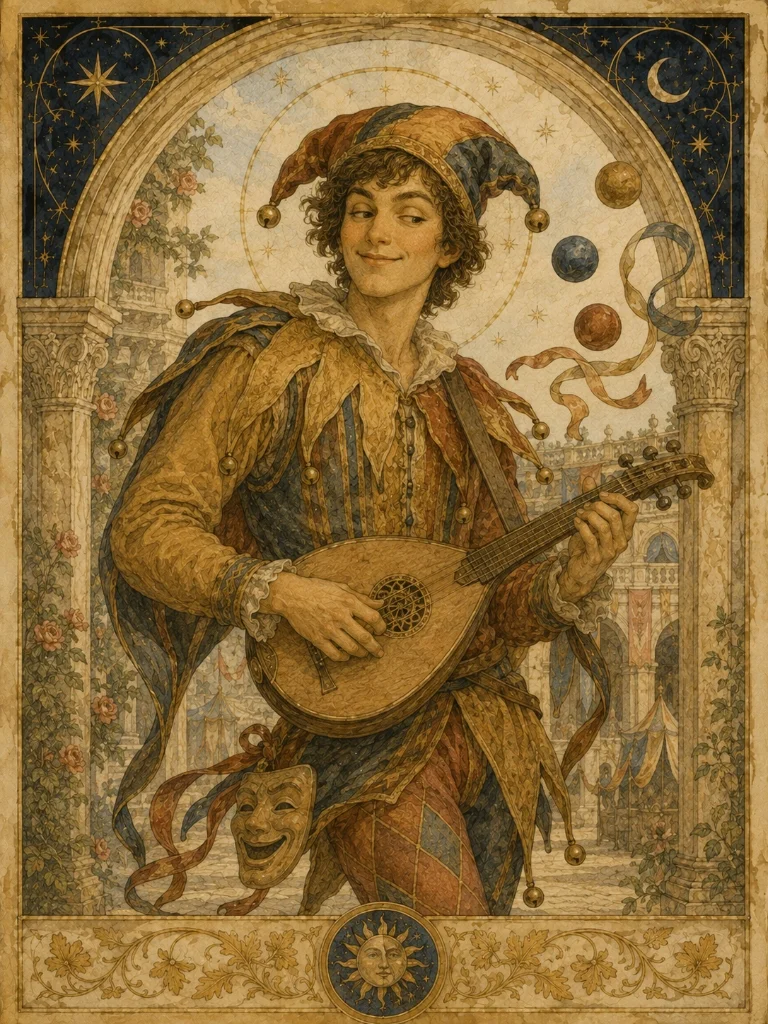
Jester
Awakens joy, disarms pretense, and embraces the vibrant lightness of the moment.
What is the Jester Archetype? Worldview and Motivation
Life is a wondrous cosmic game to be played with lightness, humor, and curiosity.
The Jester (or Trickster, Fool) archetype brings divine play, wit, and liberating laughter into a world often weighed down by solemn rigidity. The Jester reminds humanity that life is meant to be enjoyed, not merely endured.
Possessing lightning-fast wit and sharp observational clarity, the Jester punctures inflated egos and speaks forbidden truths disguised as playful banter. They remind kings and paupers alike that earthly seriousness is temporary, making the present moment sacred through sheer joy.
When integrated, the Jester does not use humor as an escape from grief or responsibility, but as a sublime spiritual antidote that dissolves despair, transforms pain into resilience, and keeps the human spirit dancing.
Core Behavioral Strategy and Action Style
Disarming tension with humor, staying spontaneous, and reframing solemnity.
Strengths
- Liberating Wit: Deftly diffuses intense social conflicts and reveals hard truths through humor.
- Spontaneous Resilience: Bounces back rapidly from setbacks with infectious optimism and creative agility.
Daily Life
- Finding unexpected humor and absurdity in frustrating daily occurrences.
- Lifting heavy workplace moods with witty remarks and playful interventions.
- Refusing to let pomposity or excessive self-importance dictate social norms.
- Living spontaneously in the present rather than fretting endlessly over hypothetical futures.
- Engaging others through entertainment, laughter, storytelling, and warmth.
Relationships
Playful, fun-loving, charismatic, and affectionate. Brings endless laughter and fresh air to partnerships.
Work and Creativity
Flourishes in comedy, satire, entertainment, advertising, creative copywriting, game design, and public speaking.
Cultural and Mythological Resonance of the Jester Archetype
Fictional Examples
Tyrion Lannister
Game of ThronesWields razor-sharp wit and irony as a shield and weapon in a deadly political arena.
Mythological Examples
Dionysus / Bacchus
God of ecstasy, festivity, theater, divine madness, and liberation from social restraints.
Loki (Trickster aspect)
The Norse trickster whose disruptive wiles provoke necessary growth and transformation.
Real-World Examples
Charlie Chaplin
Transformed poverty, war, and the machine age into poignant, universally healing comedy.
Astrological Resonances of the Jester Archetype
Planetary placements and zodiac signs in your birth chart reveal through which themes this archetype awakens.
Self-Discovery: Transformation Questions for Jester
- Am I using humor to connect with people or to deflect from real emotional vulnerability?
- Can I sit quietly with sadness without feeling an urgent need to make it funny?
- How can my playfulness bring light to someone carrying a heavy heart today?
Frequently Asked Questions About Jester
What is the core desire and motivation of the Jester archetype?
To live in the joy of the present, play, and brighten the world through humor. Behavioral strategy: Disarming tension with humor, staying spontaneous, and reframing solemnity.
How does the shadow of the Jester archetype manifest?
The shadow manifests under excessive distress, loss of autonomy, or repressed emotions.
How can I discover my dominant archetype and shadow?
Discover your primary, auxiliary, and shadow archetypes immediately by taking the 12 Archetypes Personality Test engineered on Carl Jung's analytical psychology model.
Deep Motivations and Fears
Unconscious Drive
Hidden Fear
Awakening of the Shadow
Trigger Patterns
Defensive Behaviors
Signs of Activation
Distortion of Power and Projection
Impact on Spheres of Life
Relationships
Work and Power
Integration and Illumination
Self-Discovery Questions
Cultural Resonance
Fictional Examples
Metodoloji & Kuramsal Temel
Bu içerik; Carl Gustav Jung'un analitik psikoloji kuramı (arketipler, kolektif bilinçdışı ve gölge entegrasyonu), Carol S. Pearson'ın 12 karakter modeli ve Joseph Campbell'ın monomit (Kahramanın Sonsuz Yolculuğu) çerçevesi esas alınarak Arketipya Derinlik Psikolojisi Masası tarafından hazırlanmıştır.
Referans Literatür
- Jung, C. G. (1969). Arketipler ve Kolektif Bilinçdışı (CW 9i). Princeton University Press.
- Pearson, Carol S. (1991). İçimizdeki Kahraman: Yaşadığımız Altı Arketip. HarperCollins.
- Campbell, Joseph (1949). Kahramanın Sonsuz Yolculuğu. Pantheon Books.
- Hillman, James (1983). Arketipsel Psikoloji (Archetypal Psychology). Spring Publications.
Kuramsal Uyarı: Arketipya içerikleri ve analizleri klinik teşhis veya tıbbi psikoterapi yerine geçmez; sembolik farkındalık, felsefi tefekkür ve bireyleşme (individuation) yolculuğu için yorumlayıcı bir rehber niteliğindedir.
Discover Your Dominant Archetype
Analyze your unconscious patterns, primary and secondary archetypes, and relational resonance matrix now.